《Witchfire》创作者起初讨厌 DLSS 5 现称惊艳,预期其遵循 DLSS 3 接受路径
Witchfire Creator Hated DLSS 5 at First, Now Calls It Amazing and Expects It to Follow DLSS 3’s Acceptance Path
《Witchfire》开发团队创始人 Adrian Chmielarz 在访谈中称,起初讨厌 DLSS 5,看到更好调校案例后改观,认为它将如 DLSS 3 般被接受。
本文基于 Witchfire 创作者的访谈与近期 Mod 实测,对比了 DLSS 3 初期争议与后续普及,提供 DLSS 5 需适度调校方可获认可的行业参照。
Despite the continued opposition of a portion of the gaming community, NVIDIA is clearly all-in on DLSS 5. At GTC Berlin, the GeForce company announced the imminent release of a new preset that is up to 30-40% faster (albeit at the cost of slightly less impressive graphics uplifts); the preset launched on Friday and has already been added to PC games via a variety of available injectors.
Meanwhile, the official implementation is set to expand soon. NBA 2K27 will soon be joined by Hogwarts Legacy (which will be updated on November 5), while the popular free-to-play online Wuxia action RPG Where Winds Meet is set to add DLSS 5 in late November.
While adoption slowly grows, I took the opportunity to find out what an indie developer like Adrian Chmielarz, founder of The Astronauts (The Vanishing of Ethan Carter, Witchfire), thinks about this new AI-powered technology. In my interview about the upcoming 1.0 launch of Witchfire, he candidly admitted he didn't like it at first, but he changed his mind after seeing better-tuned examples of the technology. Ultimately, he reckons DLSS 5 will be accepted like DLSS 3, which caused the infamous "fake frames" controversy (and yet, nowadays Frame Generation is ubiquitous):
I think it’s f*cking great. I think it’s amazing. The truth is that a lot of people have problems with generative AI because it looks like sh*t. If you pump up the DLSS 5 to the max, your game is going to look like sh*t. It’s going to look artificial and smudgy.
But just don’t do that. Move it just a little bit to the right, like an extra flavor. Don’t over-salt the soup. Just add a little bit of salt, and then the result is simply great. I don’t know if it’s for all games or not, but in moderation. Paracelsus said that basically everything is poison; it depends on the dose, right? You can actually get poisoned with water if you drink too much of it. It’s the same with DLSS. It is poison if you abuse it. But it’s not if you do it right.
DLSS 3 and 4, they’re not controversial anymore, right? People just use them. It’s AI, but people use it, and they have zero problem. I think the same is going to happen to DLSS 5 because I remember when it premiered, the first trailer, everybody was complaining about it. I was among them because it looked like shit. It looked really bad. But then with the leak, when some people are using it properly, you look at the screen and you go, “this actually looks decent. I prefer that version of the game because there’s more detail.” It’s a very interesting thing, DLSS 5.
Over the past few days, Infinity Ward's Call of Duty: Modern Warfare 4 blew up on YouTube and social media as footage of the game's campaign with injected DLSS 5 looked extremely lifelike.
Modding innovation continues unabated, too. Two different modders have implemented the VR-derived technique Foveated Rendering into DLSS 5 injectors to improve performance. Foveated Rendering keeps the full rendering solution at the center of the screen while reducing it at the edges, thus increasing frame rates.

The same concept is applied to NVIDIA's Neural Rendering: FoveatedDLSS 5, which was primarily developed with Ultrawide and Super-Ultrawide displays in mind, works like this:
DLSS 5 NR only runs at a single, fixed resolution per evaluation. So instead of mixing resolutions, the add-on squeezes the frame before NR and stretches NR's result back:
output 7680×2160 NR working image 5540×2132
┌──────┬────┬──────────┬────┬──────┐ ┌───┬───┬──────────┬───┬───┐
│ 50 % │ramp│ 100 % │ramp│ 50 % │ → │ │ │ centre │ │ │
│ │ │ 3000×1800│ │ │ │ │ │ 1:1 copy │ │ │
└──────┴────┴──────────┴────┴──────┘ └───┴───┴──────────┴───┴───┘
- Inside the centre zone, pixels are kept 1:1.
- Over the fall-off, resolution blends smoothly (smoothstep, no visible seam) down to the edge value.
- Beyond the fall-off, resolution stays at the edge value. Horizontal and vertical are independent, so corners get edge × edge (0.5 × 0.5 = 25 % of the pixels).
- NR runs once on the smaller image, with one temporal history.
- The game's depth and motion vectors are squeezed the same way, so NR's inputs stay aligned with the image.
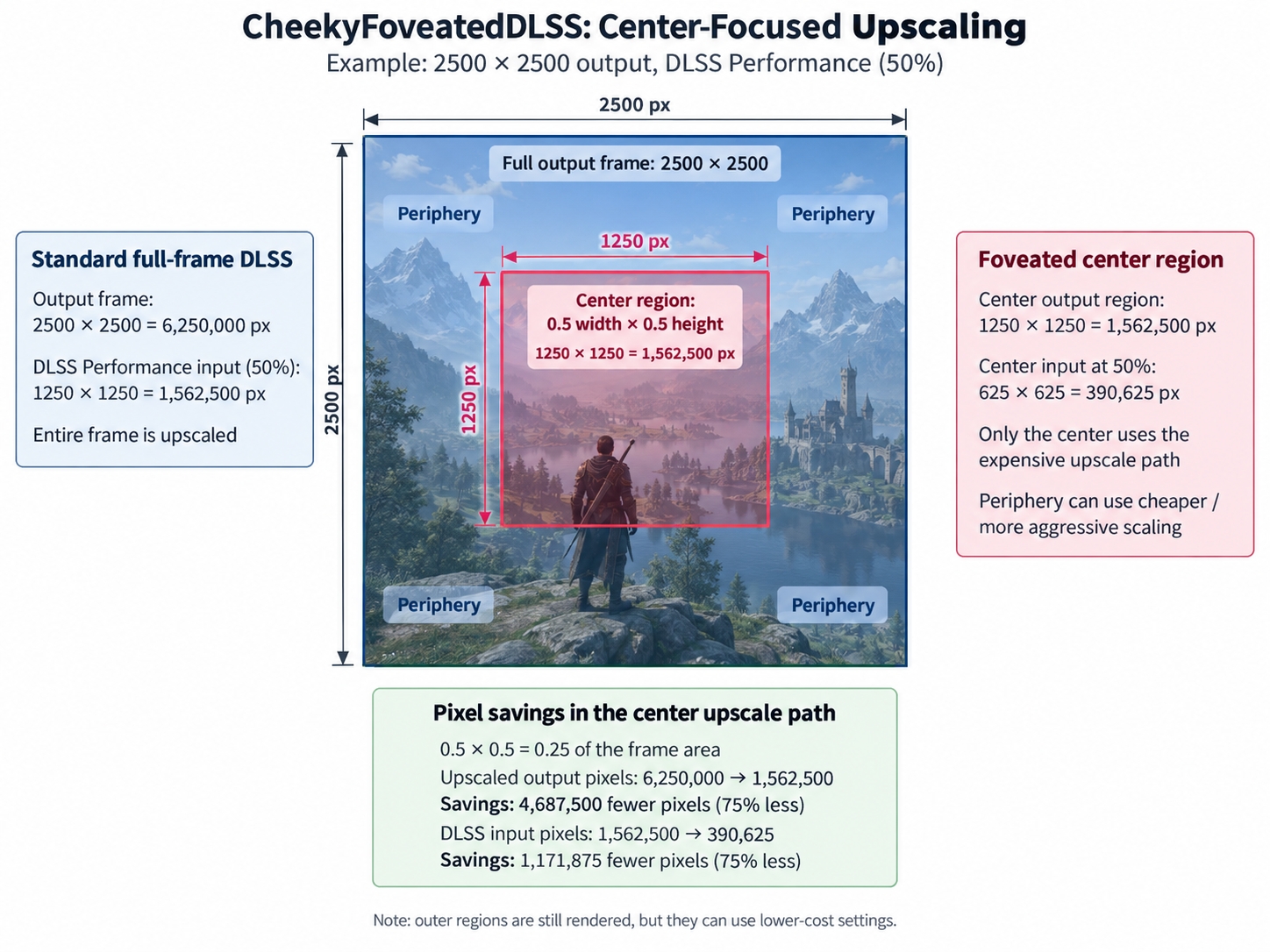
CheekyFoveatedDLSS actually implements the same concept for Super Resolution, too, while still supporting NVIDIA's Neural Rendering:
Reduce the cost of DLSS Super Resolution by concentrating it on the center of the image. Available as a UEVR plugin or a standalone integration for Vulkan, Direct3D 11 and Direct3D 12 games. With DLSS Performance, FPS gains of 20%+ are standard, even more with eye-tracked headsets, which can make the foveated region even smaller. This also supports foveating DLSS Neural Resolution (DLSS 5), including running it pre-upscale and at lower resolutions (improves performance at a cost of quality).

About the author: With over two decades of experience in gaming journalism, Alessio Palumbo has led the gaming vertical at Wccftech since August 2015. He started working at a young age for Italian websites like Everyeye.it, Gamestar.it, Nextgame.it, and Multiplayer.it before kickstarting the indie English-language publication Worlds Factory as its founder and Editor in Chief. In the last decade, he has coordinated the overall output of Wccftech's gaming section, managed PR relations, assigned reviews, produced daily news coverage, edited gaming content as needed, and delivered game reviews. Arguably, his trademark content is the long series of exclusive developer interviews that have been cited by Wikipedia and by the biggest news media and gaming publications. His passion for technology also makes him knowledgeable when it comes to gaming hardware and tech. His favorite genres include RPGs, MMORPGs, and action/adventure games.
Follow Wccftech on Google to get more of our news coverage in your feeds.
来源:Wccftech · wccftech.com